
Record date:
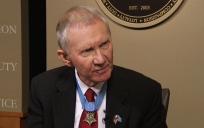
Medal of Honor Recipient John F. Baker, Jr. Interview
John Baker had been a gymnast in high school before he joined the Army. One day, near Tay Ninh Province in South Vietnam, he put the first lesson of gymnastics to pretty good use: if you fall down, get right back up and keep going.
On that day in 1966, nothing could keep then-PFC John Baker down. His unit was called in to assist another company that had been overwhelmed by the Vietcong, in an area draped with jungle and a dense network of tunnels. As soon as Baker's unit entered the area, a ferocious hail of machine-gun fire erupted from the enemy hidden in trees and bunkers covered in thick foliage. The lead man in his column went down, but Baker stayed up; he spotted two bunkers and charged them, then took out four Vietcong while dragging his wounded comrades to safety. After he returned to battle, he was knocked down by a grenade blast, but got back up again; over the next two hours, he destroyed four more bunkers, killed four more Vietcong, and saved seven more wounded soldiers.
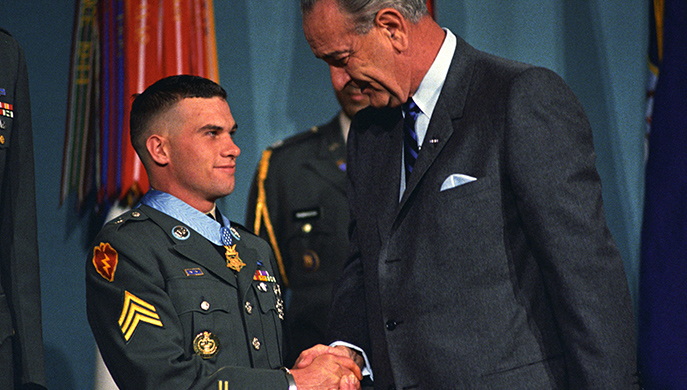
Baker was recommended for the Medal of Honor by the men he served with that day. In memory of the soldier who wouldn't stay down, they made sure the recommendation kept standing all the way to President Lyndon Johnson. Over the course of his twenty years of service, he also earned the Silver Star, Bronze Star, Purple Heart, and Meritorious Service Medal. Baker is the former Vice President and current Sergeant-at-Arms Emeritus of the Congressional Medal of Honor Society.
His Citation Reads:
Rank and organization: Sergeant (then PFC), U.S. Army, Company A, 2d Battalion, 27th Infantry, 25th Infantry Division. Place and date: Republic of Vietnam, 5 November 1966. Entered service at: Moline, Ill. Born: 30 October 1945, Davenport, Iowa. Citation: For conspicuous gallantry and intrepidity in action at the risk of his life above and beyond the call of duty. En route to assist another unit that was engaged with the enemy, Company A came under intense enemy fire and the lead man was killed instantly. SGT Baker immediately moved to the head of the column and together with another soldier knocked out two enemy bunkers. When his comrade was mortally wounded, SGT Baker, spotting four Viet Cong snipers, killed all of them, evacuated the fallen soldier and returned to lead repeated assaults against the enemy positions, killing several more Viet Cong. Moving to attack two additional enemy bunkers, he and another soldier drew intense enemy fire and SGT Baker was blown from his feet by an enemy grenade. He quickly recovered and single-handedly destroyed one bunker before the other soldier was wounded. Seizing his fallen comrade's machine gun, SGT Baker charged through the deadly fusillade to silence the other bunker. He evacuated his comrade, replenished his ammunition and returned to the forefront to brave the enemy fire and continue the fight. When the forward element was ordered to withdraw, he carried one wounded man to the rear. As he returned to evacuate another soldier, he was taken under fire by snipers, but raced beyond the friendly troops to attack and kill the snipers. After evacuating the wounded man, he returned to cover the deployment of the unit. His ammunition now exhausted, he dragged two more of his fallen comrades to the rear. SGT Baker's selfless heroism, indomitable fighting spirit, and extraordinary gallantry were directly responsible for saving the lives of several of his comrades, and inflicting serious damage on the enemy. His acts were in keeping with the highest traditions of the U.S. Army and reflect great credit upon himself and the Armed Forces of his country.