






Record date:
USO U-505 Naval History Program
In cooperation with the Museum of Science and Industry and with the generous support of Tawani Foundation, the Museum & Library supports the training of Navy Chief Petty Officer (CPO) selectees by hosting and sponsoring activities related to the USO of Illinois' U-505 Naval History Program.
This video was created by USO of Illinois.
The first of its kind in the nation, created by the USO of Illinois, the program connects the American public with future U.S. Navy chief petty officers in a mutually beneficial partnership between the American public, military learning institutions and the naval population at the nation’s only Navy boot camp—Naval Station Great Lakes, just north of Chicago.
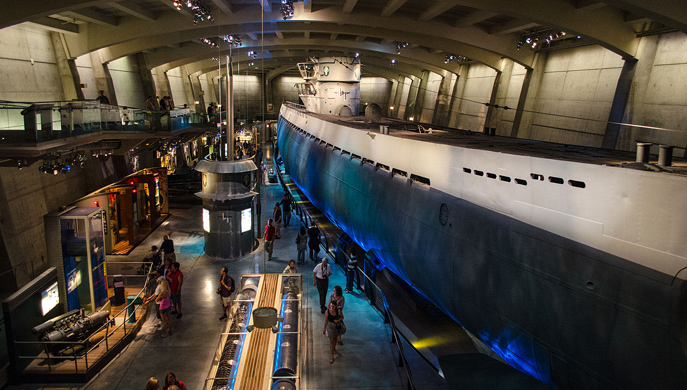
CPO selectees travel to MSI and the Pritzker Military Museum & Library for a day of training on the history and artifacts related to the U-505—the only German U-boat captured during World War II—and to conduct research on naval leadership. Now located in a 35,000-square-foot exhibit at MSI, the vessel is extremely relevant to the U.S. Navy experience and serves as a national war memorial for those who lost their lives in the two battles of the Atlantic during World Wars I and II. U.S. submariner veterans also join in the training to impart their knowledge and experience to the selectees, building connections between future Navy Chief Petty Officers and past generations.
Navy Chief Petty Officers serve as not only technical experts, but as exemplary leaders who possess high personal and professional standards. CPO selectees then volunteer at the U-505 Submarine exhibit for several days in early September, answering questions and engaging museum guests with various submarine-related artifacts. Museum guests have an opportunity to not only learn about the U.S. Navy’s heroic effort during World War II and how those actions changed history, but to also gain a greater awareness and appreciation of the men and women serving in uniform.



2014 U-505 Naval History Program Winning Essay
Turning Point in U-Boat Reign of the Atlantic, by Chief Angela DeRosa
To understand the significance of capturing the U-505 for Allied Forces, first you must understand the reign of terror that U-boats posed during World War II. Commodore Karl Doenitz was given command of all U-boats on January 28, 1939, making famous his tactical strategy known as the “Wolf Pack.” Doenitz’s first Wolf Pack attack was in September 1940, when he was able to sink 16 British ships with only 10 U-boats; a month later, he further perfected this tactic by sinking 32 Allied ships with only 12 U-boats.
On December 7, 1941 America entered the war. Then, in January 1942, Hitler granted Doenitz permission to strike at the U.S. in what came to be known as Operation Paukenschlad (“Drum Roll”). In May 1942, the number of U-boats operating on the Eastern Seaboard reached a high of 30 vessels; at the same time, German experts conclude that if a monthly average of 700,000 tons of Allied Merchant Ships could be sunk for the rest of the year, Britain's war effort would be doomed. During thefinal months of 1942, U-boats were sinking an average of 650,000 tons—taking into consideration the sinking of Allied ships by Axis aircraft, mines and surface ships, Germany seemed on the verge of achieving their goal.
Another obstacle Allied Forces were facing was to break the Enigma Code. The Enigma Machine had a very intricate coding system allowing an operator to type a message, then scramble it by means of three to four rotors which displayed different letters of the alphabet. What made this undecipherable was that the receiver had to know the exact setting of the rotors to be able to read the message.
By 1944, Allied forces were able to intercept the frequency the Axis Powers were using to send encrypted messages. This is what led to the capture of the U-505. June 4, 1944 Captain Daniel V. Gallery, against much adversity and impossible odds, captured a U-boat, along with a 58 German sailors. Towing the U-boat to Bermuda and enforcing Operational Security for his entire crew, Gallery was able to convince the Germans that U-505 had sunk and the crew had died at sea.
Allied Forces possessed an Enigma Machine, code books, and a crew that knew how to use them—they were now hunting U-boats, rather than being hunted by them. With a U-boat to study, Allied Forces were able to locate weaknesses in the structure, allowing forces to deliver more devastation when firing on enemy submarines. Allied Forces were also able to take the strengths of the U-boat’s technology and apply it to their own vessels.
In September 1944, Doenitz began to lose hope of defeating Allied Forces. Allied convoys were able to either evade U-boat attacks or beat down the Wolf Packs. On November 12, 1944, Doenitz— knowing that the enemy knew his secrets—abandoned the Wolf Pack strategy and ordered all U-boat commanders to operate individually. Losing only eight Allied ships in convoy, 136 U-boats were defeated. The tables were now reversed in favor of the Allied Forces.