








Record date:
2016 Founder's Literature Award: Sir Alistair Horne
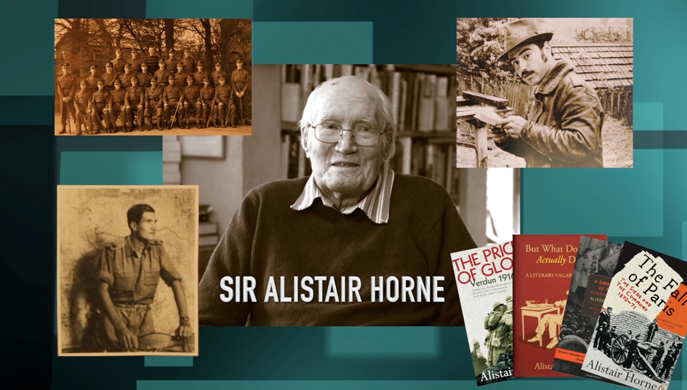
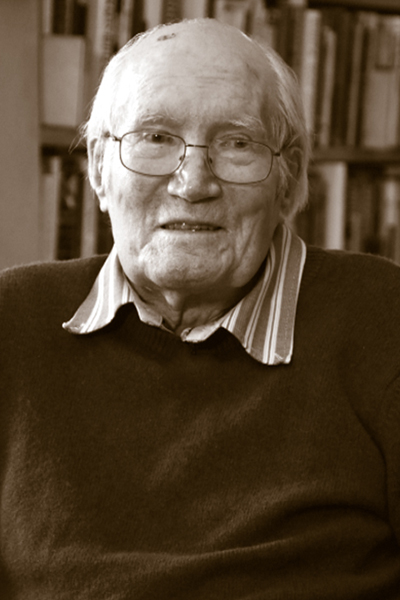
Sir Alistair Horne, was born in 1925 and educated at Le Rosey school in Switzerland. As a teenager early in World War II, Horne was sent to live in the United States. He attended Millbrook School, where he befriended William F. Buckley, Jr., who remained a lifelong friend. He graduated from Jesus College, Cambridge as a Master of Arts. Horne served in the Royal Air Force in 1943–44 and later as an officer in the Coldstream Guards from 1944 to 1947.
Sir Alistair worked for British military intelligence in the opening period of the Cold War and was a foreign correspondent for the Daily Telegraph from 1952 to 1955.
His strong connections with the United States continued as a Fellow of the Woodrow Wilson Institute in Washington DC. But he is best known for his works of French military history. They include:
The Price of Glory – Verdun
The Fall of Paris: The Siege and the Commune 1870-71
To Lose a Battle – France 1940
A Savage War of Peace – Algeria 1954 – 1962, which was awarded the Wolfson Prize for History. This book was recommended by Henry Kissinger to President George W. Bush just before the Iraq War and was closely studied by the U.S. Army afterwards.
With Viscount Montgomery, the son of the Field Marshal, Sir Alistair wrote The Lonely Leader – Monty 1944-45.
Feeling strongly that the historians of the future need every encouragement, he set up and endowed the Alistair Horne Fellowship at St Antony’s College, Oxford, to advance the research and work of young historians.
Sir Alistair was made an Honorary Fellow of St Antony’s College, and in 1993 he received the degree of Doctor of Litterature from the University of Cambridge. A recipient of a number of awards, Chevalier of the Legion of Honour in France, and Commander of the British Empire, Horne was knighted for his work as a historian and for international relations.
His most recent book, Hubris – The Tragedy of War in the 20th Century was published last year to great acclaim. At the age of ninety, it is a feat which any historian might envy.