




Record date:
U-505 Naval History Program: 8th Annual Fulfillment Ceremony
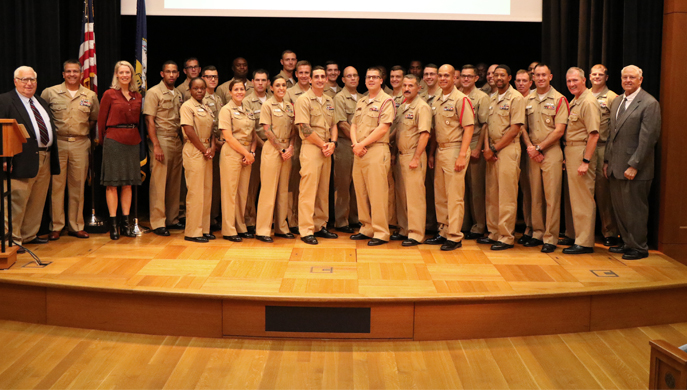
In cooperation with the Museum of Science and Industry and with the generous support of Pritzker Military Foundation, the Museum & Library supports the training of Navy Chief Petty Officer (CPO) selectees by hosting and sponsoring activities related to the USO of Illinois' U-505 Naval History Program.
The first of its kind in the nation, created by the USO of Illinois, the program connects the American public with future U.S. Navy chief petty officers in a mutually beneficial partnership between the American public, military learning institutions and the naval population at the nation’s only Navy boot camp—Naval Station Great Lakes, just north of Chicago.
CPO selectees travel to MSI and the Pritzker Military Museum & Library for a day of training on the history and artifacts related to the U-505—the only German U-boat captured during World War II—and to conduct research on naval leadership. Now located in a 35,000-square-foot exhibit at MSI, the vessel is extremely relevant to the U.S. Navy experience and serves as a national war memorial for those who lost their lives in the two battles of the Atlantic during World Wars I and II. U.S. submariner veterans also join in the training to impart their knowledge and experience to the selectees, building connections between future Navy Chief Petty Officers and past generations.
Navy Chief Petty Officers serve as not only technical experts, but as exemplary leaders who possess high personal and professional standards. CPO selectees then volunteer at the U-505 Submarine exhibit for several days in early September, answering questions and engaging museum guests with various submarine-related artifacts. Museum guests have an opportunity to not only learn about the U.S. Navy’s heroic effort during World War II and how those actions changed history, but to also gain a greater awareness and appreciation of the men and women serving in uniform.


2018 U-505 Program Winning Essay
Defining Our Past and Guiding Our Future, by Jeremy Saunders
The German U-boat posed a considerable challenge for a significant portion of World War II. Machinery and technology allowed Navies to destroy from afar while presenting minimal risk to the crew. The Battle of the Atlantic saw U-boats patrol the entire ocean, decimating supply lines. Over time, our aircraft leveled the playing field by being able to patrol for U-boats safely from the sky. This represented a different medium for technological superiority. Considering the massive technological advances on both sides, it is reasonable to think that science alone wasn’t the decisive factor in victory. In this case, an important aspect in regards to waging war in the Atlantic is how the maximization of human effort can lead to victory when combined with technology.
In order to capture a U-boat, Admiral Gallery felt it necessary to break from the idea of utilizing only technological superiority. Early on in his days of running the Hunter-Killer Task Group, Admiral Gallery was interested in finding out how far we could push pilots and aircraft. Even with recent improvements to fuel capacity, Admiral Gallery would push the pilots to remain in flight to the utter brink of failure. The planes had the ability to scan far more of the ocean surface than the sonar used at the time. Due to the fact that the U-505 ran on electric battery while submerged, it was required to surface at least once a day to recharge the battery by running the diesel engines. These recharges usually occurred under the cover of darkness. Admiral Gallery pioneered the tactic of sending aircraft out on night patrol under a full moon to have a greater chance of catching a surfaced U-boat. His pilots were pushed to the edge of their ability. This maximization of pilot effort eventually paid off when on June 4, 1944 they had finally corralled the sub and the USS Chatelain caught sight of it from 700 yards away.
In 1944, it had been over 100 years since boarding parties were a standard operating procedure when capturing a naval vessel. In the planning stages for the successful deployment, Admiral Gallery had ordered the Commanding Officers of the ships in the Hunter Killer Task Group to identify a boarding party from among their crews. Ultimately, it was the boarding party from the USS Pillsbury who got the call to board and the opportunity to put their bravery and commitment on display. For all the men of the boarding party knew, the Germans had sabotaged the U-boat and were leaving it as a trap for the Americans. Their courage and the technical expertise they held, allowed them to go aboard a foreign submarine and stabilize it.
In both examples above, Admiral Gallery showed that it wasn’t enough to rely on technology to win a war. He understood that, in order to win, you must maximize your human resources both in terms of technical expertise and courage. The capture of U-505 showed that there could be no substitute for bravery.