






Record date:
2017 Pritzker Literature Award Presentation: Peter Paret
Award-winning author and historian, Peter Paret is the recipient of the 2017 Pritzker Military Museum & Library Literature Award for Lifetime Achievement in Military Writing.
Author of 14 major publications, including Clausewitz and the State: The Man, His Theories and His Times and Imagined Battles: Reflections of War in European Art, Paret has gained recognition for his research that brings together intellectual history and cultural history in order to better understand the relationship between the military and society more broadly.
Paret’s interest in military history emerged from his own military service in the Pacific Theater of World War II. Although he admittedly had a deep interest in literature and art, his service had left him with questions about how historians discussed warfare and how nations and citizens focused their energies towards military efforts. Towards that end, Paret’s writing has always been characterized by its quest to understand the intricate web of actions and ideas that affect the military on and off the field of battle and to expand the definition of military history to examine its impacts on politics, society, and art.
Paret’s wide interests have allowed him throughout his long career to enrich the field of military history more than many other historians. Paret was a co-founder of the “Clausewitz Project” at Princeton, which sought to understand the intellectual and cultural world that fostered the military writings of Carl von Clausewitz.
In 1991, Paret shifted the discipline, proposing the study of a “new military history” that seamlessly united warfare with contemporary cultural and political events. This crossing of intellectual categories to unite seemingly disparate areas of study marks Paret’s work as unique and bold.
“I am very happy to receive this award and most grateful to the distinguished panel of historians of war for choosing me as the recipient of the 2017 Pritzker Literature Award.”
- Peter Paret on receiving the Pritzker Literature Award
Candidates for the Pritzker Literature Award are nominated each year by a committee of historians, authors, and executives, and the final selection is made by Museum & Library Founder Jennifer N. Pritzker. The 2017 Screening Committee is chaired by John W. Rowe and includes past Literature Award recipients Antony Beevor, David Hackett Fischer, Tim O'Brien, and Hew Strachan; Colby Award Winner Karl Marlantes; Executive Director of the 1st Divison Museum at Cantigny Paul Herbert; President & CEO of the Chicago History Museum, Gary Johnson, and ex-officio member Kenneth Clarke.
PETER PARET is a graduate of London University, the Professor Emeritus in the School of Historical Studies at the Institute for Advanced Study, a member of the American Philosophical Society, a Fellow of the American Academy of Arts and Sciences, and a Fellow of the Leo Baeck Institute for German-Jewish History.
A recipient of the Thomas Jefferson Medal of the American Philosophical Society and the Commander’s Cross of the Order of Merit from the Federal Republic of Germany, Paret is a distinguished scholar across subjects, disciplines, and international boundaries. Paret is also a WWII veteran having served in the U.S. Army in the Pacific Theater.
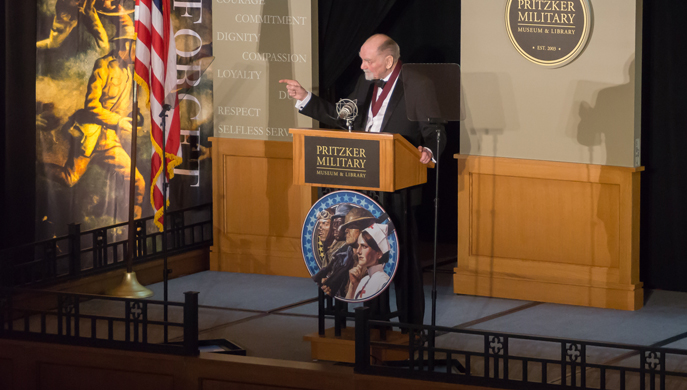
Peter Paret's Lecture at the 2017 Liberty Gala
Peter Paret, War and its Historians, By Peter Paret 1
I welcome the opportunity to express my thanks for this award with a few observations on some of the different ways in which we study the history of war. Let me begin by characterizing the subject: War – the organized intent to kill on a large scale – is a unique act of human behavior; a singular reality, but one shaped by the social, institutional, and political conditions surrounding it. Often this civilian context determines the military outcome. Here a historical example: In the mid-eighteenth century Prussian infantry became feared for their precise execution of linear tactics, the result of the rank and file, mainly serfs and foreigners serving for pay, being beaten into mechanically responding to orders. 2 Against the socially more cohesive, often advantage faded. But in the final Napoleonic campaigns, after Prussia abolished serfdom, making more humane treatment obligatory and more mobile tactics possible, her infantry regained its superiority. Exploring such links between civilian realities and military effectiveness may take the study of war into social or intellectual history, and not every subject calls for this expansion. But that the links exist should be recognized and kept in mind.
Now a second observation, this one about historians. They are not alone in interpreting the past. Many of their readers do not automatically accept the findings historians offer. And there have always been others who, whatever their occupation, seriously study aspects of the past and express their own conclusions. Historians function in a world of non-scholarly observers and analysts of history.
Among these non-historians are artists and writers. They may be mainly interested in emo-tions rather than events – not that emotions are absent from war - and the arts address both. The Iliad tells us something of early Greek warfare. Goya’s etchings The Disasters of War reveal how Spanish customs shaped the country’s resistance to Napoleon – as Clausewitz summed up, “The Spanish War spontaneously became the concern of the people.” 3 Tim O’Brien has given us a fictional but true account of American soldiers in Vietnam. 4 Since the first cavemen scratched a hunt on rock – and accounts of the present soon become testimony of the past – the arts have recorded history, to be sure often by visualizing religious beliefs.
To further illustrate this aesthetic concept of history, as modern as it is ancient, let me now mention a work by an early twentieth-century poet, who chose war as his subject. First the background. By 1914 the German General Staff had concluded that in the war clearly coming, Germany must defeat France before shifting forces east to block the expected, more slowly developing Russian threat. Since an offensive across strongly defended eastern France could not succeed in time, it was decided to launch an envelopment towards Paris from the north, through neutral Belgium. 5 In August 1914 operations began accordingly, although last-minute caution led to the transfer of troops to East Prussia, which weakened the attack’s right wing. By early October German forward units had nevertheless reached the Belgian town of Ypres, 23 miles from the British Channel. Then British forces reoccupied the town, and, taking heavy casualties, held it against repeated German assaults that persisted until November, to resume the following spring. But Ypres did not fall, and the war shifted from the strategically promising but politically questionable Schlieffen Plan to two years of murderously inconclusive fighting on the western front, until the arrival of American forces in 1917 broke the deadlock and led to Germany’s defeat, which in turn fifteen years later led to the Third Reich.
At the beginning of the war, Great Britain still relied on a volunteer army rather than on universal military service, and German newspapers took note of the to them unusual mer- cenary nature of the British Expeditionary Force. That caught the attention of the British poet A.E. Housman, author of a group of widely known poems, A Shropshire Lad, that cele- brate the energy and idealism of young men of college age, but also note the loneliness and stress in their lives. 6 Housman now wrote a new poem, Epitaph on an Army of Merce- naries. He recognized similarities between the privileged youth his earlier work addressed and the “mercenaries” who sacrificed themselves to defend a position of value to the na-tion. That they served for pay he considered not immoral, but a necessity – for the poor, fighting was work they needed. Their heroism was real, even as it mirrored the facts and conflicts faced and overcome in every young life seriously led – the soldier’s war, we might say, reflecting the war of life.
I’ll now read the eight lines of Housman’s poem:
These, in the day when heaven was falling,
The hour when earth’s foundations fled,
Followed their mercenary calling
And took their wages and are dead.
Their shoulders held the sky suspended;
They stood and earth’s foundations stay;
What God abandoned, these defended,
And saved the sum of things for pay.
Housman’s verses affirm the achievement of ordinary men, a reality often ignored in histo- ries of significant events in war or peace. By emphasizing individual will in an age of mass armies, they add a powerful image to our mental picture of the First World War. 7 To con- clude, historians and poets reflecting on the past have much to say to us and to each other: the historian clarifies the political-military beginning of the First World War; the poet, by deepening our understanding of an episode of this war, deepens our understanding of war itself. Each can learn from the other: history teaches the force of research and interpreta- tion, sharpened by centuries of methodological refinement; the arts convey the power of the unfettered imagination. Both penetrate the past, even if they cannot always escape one-sidedness. And as I suggested at the start of these remarks, we as readers may complete the process of interpretation with our own critical and constructive reception of their conclusions.
Footnotes:
1. On receiving the Pritzker Lifetime Achievement Award in the Historical Study of War.
2. After the Canton Regulations of 1733, which determined the basis of military service in Prussia until the Wars of Liberation, each regiment was assigned a particular district that together with the recruitment of foreigners, provided the needed manpower, drawn from the poor, unprivileged segments of the population. Whipping these soldiers was regarded as a permissible part of training, not as punishment. As Reinhard Höhn, a historian not known for his sympathies with democracy and the rights of man, correctly notes, “in the army [whipping] was raised to a system that was linked as closely as possible with the rational functioning of the military machine.”
3. Carl von Clausewitz, Book VIII, ch. 3, On War, ed. and transl. Michael Howard and Peter Paret, Princeton, 1989, p. 592.
4. Tim O’Brien, The Things they Carried, New York, 1991.
5. The development of the Schlieffen Plan to its ultimate flawed execution has been brilliantly reconstructed by Gerhard Ritter in his Der Schlieffen-Plan – Kritik eines Mythos, Munich, 1956.
6. Housman’s life and work are the object of an excellent recent study by Peter Parker, Housman Country, New York, 2016.
7. By one of the dreadful ironies of history, the costly but unsuccessful German assaults against the Ypres Salient in October 1914 were carried out in part by thousands of student-volunteers, similar in background and outlook to the young college students Housman memorialized in A Shropshire Lad.
Published by permission of the author, December 2017